

Alexandr Berdyugin: Compliance is not about Control - It’s about Culture

- What principles, in your view, form the foundation of an effective compliance system in an investment company?
- In compliance, as in business generally, everything starts “at the top.” Genuine engagement of shareholders and management in shaping a culture of adherence to requirements is the key foundation of an effective system.
As we grow the business, we strive not only to protect profitability but also to ensure compliance with laws, ethical standards, and a culture of conduct — the rules by which a company operates within society.
We operate under an investment licence, which means a broad range of regulatory requirements applies to us. A purely formal approach simply does not work in this environment.
If we focus on the core principles, they are independence of the compliance function, a risk-based approach, and transparency of processes. Each of these elements is important on its own, but they truly work only together, forming a cohesive internal culture within the company.
- To what extent does the development of new technologies, digital assets, and alternative financial instruments influence compliance approaches?
- It has a significant impact. More broadly, compliance as a profession is relatively young in our market. Its development has largely been driven by technological progress.
In many emerging areas, the process follows a similar pattern: first an idea appears, then it is implemented and scaled, and only afterwards comes the understanding that the interests of all participants must be safeguarded and that clear rules and frameworks are required. Once those rules are established, what was once new becomes part of everyday life. A new reality is accepted.
The same has happened with digital assets, alternative instruments, and new financial technologies. Compliance is not a restrictive factor; rather, it is a mechanism that helps integrate innovation safely and organically into the existing system.

- What led you to the field of compliance, and why did it become your professional choice?
- Like many people, at the beginning of my career I did not have a clearly defined calling. I did not see myself as a pilot, an artist, or a doctor, but I was always interested in analysing businesses “in detail” and understanding how an organisation functions from the inside.
It did not matter whether it was a small cafeteria, a car dealership, or a large industrial holding - any business can be broken down into processes to identify where it operates efficiently and where adjustments are needed.
When I was pursuing my higher education, risk management was actively developing and being implemented in the banking sector. Later, similar approaches were introduced into insurance and investment businesses. Over time, compliance and AML were added to risk management. Step by step, this formed a comprehensive specialisation.
Importantly, each of these areas was new not only for individual companies but for Kazakhstan as a whole. This allowed us to gain hands-on experience and build the expertise required for the market.
- What personal qualities have been most important for you in your role as Chief Compliance Officer?
- First and foremost, attention to detail. It allows one to see the full picture beyond documents and regulatory requirements. It is important for me to understand the underlying business process and communicate my perspective to its owner so they can view their work from a different angle.
The second critically important skill is communication. We are all used to speaking in our “own language,” but often people need translation.
And, of course, continuous learning is essential. The environment changes rapidly, and a compliance officer must be able to adapt without losing depth or quality. After learning and understanding something new, you realise how many strong ideas exist and how their implementation can improve your work.
- How would you describe Fonte Capital’s approach to compliance within the framework of AIFC requirements and standards?
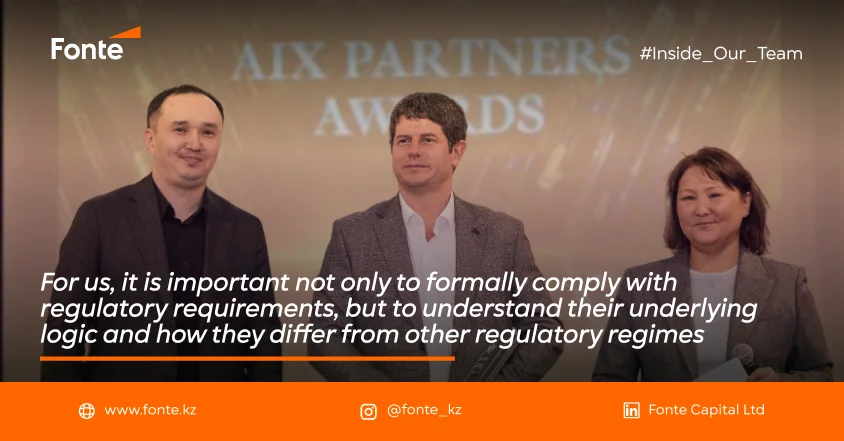
Our approach is directly linked to the specifics of the AIFC. For us, it is important not merely to formally comply with requirements but to understand their logic and how they differ from other regulatory regimes.
At the same time, the AIFC operates within the legal framework of the Republic of Kazakhstan, which itself is integrated into the international regulatory system. As a result, our approach can be described as a “matryoshka principle”: from the basic CIS licence requirements to more complex and comprehensive regulation.
This approach enables us to build the system sequentially without placing unnecessary strain on the business. We also receive substantial support from the regulator, particularly when acting as pioneers in implementing new solutions or approaches.
- What does it mean to you to be part of the Fonte Capital team today?
- For me, it is about understanding shared goals and preserving common values. This creates an atmosphere of trust, openness, and mutual support.
My role, and that of the leadership team as a whole, is to communicate these values to every employee so that everyone understands where we are today and where we are heading.
In today’s environment, a team is a flexible structure, and without continuous interaction it can easily lose focus. In such cases, it is not an individual who loses — it is the entire company.
- What inspires you and gives you the strength to move forward, both professionally and personally?
- Results. It is important for me to see that work and decisions lead to tangible outcomes. Not everything turns out perfectly, but even imperfect results provide experience and new conclusions. That, in turn, is forward movement.
- How do you recharge during periods of high workload and responsibility?
- There is no perfect formula. It is usually a combination of rest, physical activity, and a change of routine. In the short term, it is important simply to step away from the current pressure and switch focus.
Most often, good sleep makes the difference, but physical activity also has a powerful effect. Sometimes by the evening my “battery” is almost empty, but after an hour in the swimming pool I feel completely different - with a clear head and renewed energy.
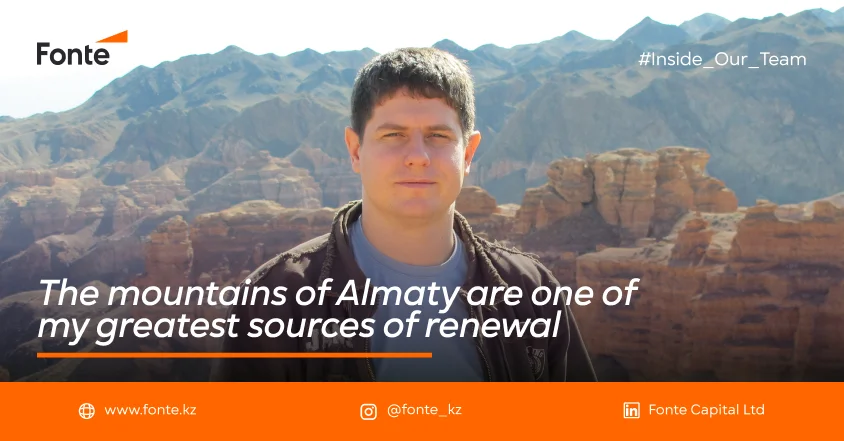
On weekends and holidays, a change of environment helps most. We have a beautiful park nearby, and the mountains of Almaty are one of my best sources of recovery.
In the long term, everyone needs a proper vacation. Without it, burnout is inevitable, and recovery can take months. I have noticed that when your usual environment changes, your mind works differently. Many people have felt that one week on vacation feels like a month, while a month at work feels like a week. That is a strong indicator of how essential a reset truly is.
- Do you have a motto or principle that guides you both professionally and in life?
At the same time, I do not believe proactivity should be absolute. Sometimes it is important to pause and allow a situation to “mature.” As the saying goes, the morning is wiser than the evening. Sometimes it is better to sleep on a question and return to it the next day. In the morning, a different perspective and more options often appear.
The same principle applies at work. What may seem like a dead end or a critical problem at the moment often stops looking that way with time. Sometimes the right solution simply has not matured yet.