

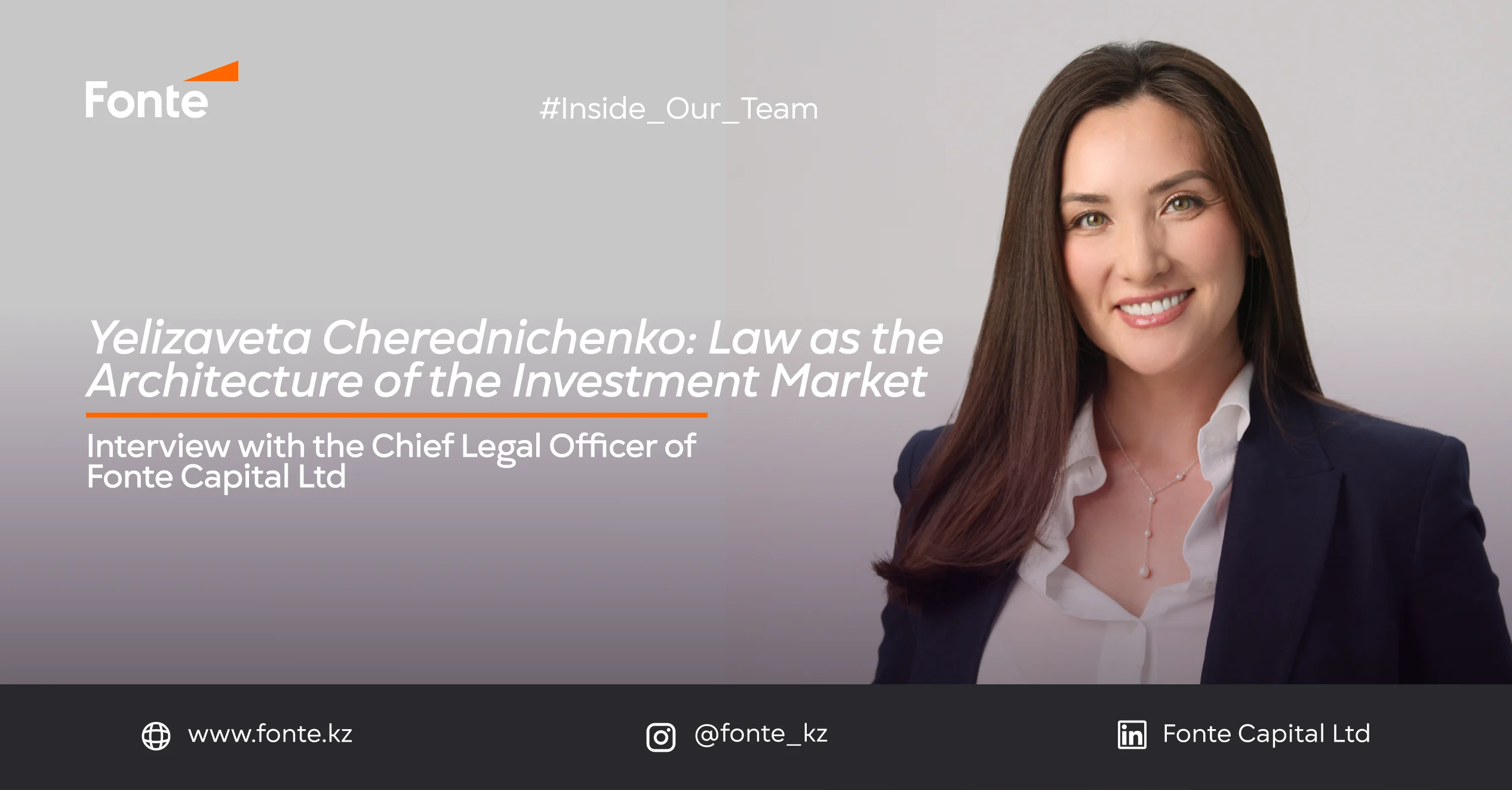
Yelizaveta Cherednichenko: Law as the Architecture of the Investment Market
Interview with the Chief Legal Officer of Fonte Capital Ltd
In the investment industry, legal infrastructure serves as the foundation of trust, resilience, and scalability. Behind every new financial instrument stands a complex legal architecture capable of withstanding market volatility, regulatory scrutiny, and investor expectations.
In the new issue of Inside Our Team, we spoke with Chief Legal Officer Yelizaveta Cherednichenko about how investment funds unique to the region are structured, what the main challenges are when launching new financial instruments, and what truly defines the profession of a modern lawyer in an investment company.
You participated in launching investment structures unique to the Central Asian market — umbrella funds, a credit fund, and crypto ETFs. What challenges did you face in the absence of local precedents?
The main challenge is that you cannot simply call a colleague and ask how they solved a similar issue - because no one has solved it before. The regulator does not yet know how to approve it, the infrastructure does not know how to service it, and investors do not fully understand what they are buying.
You are essentially sitting with a blank sheet of paper, assembling a product from components that do not always fit perfectly together: corporate structure, investor rights, NAV calculation, transaction mechanics — everything at once. It all has to be consistent, and there is no guidebook telling you “this is how it should be done.”
And then there is a separate challenge: explaining everything to investors in clear language, without turning documentation into an academic treatise. That task is far more complex than it seems.
Was there a moment when you felt: “We are creating something fundamentally new and important for the market”?
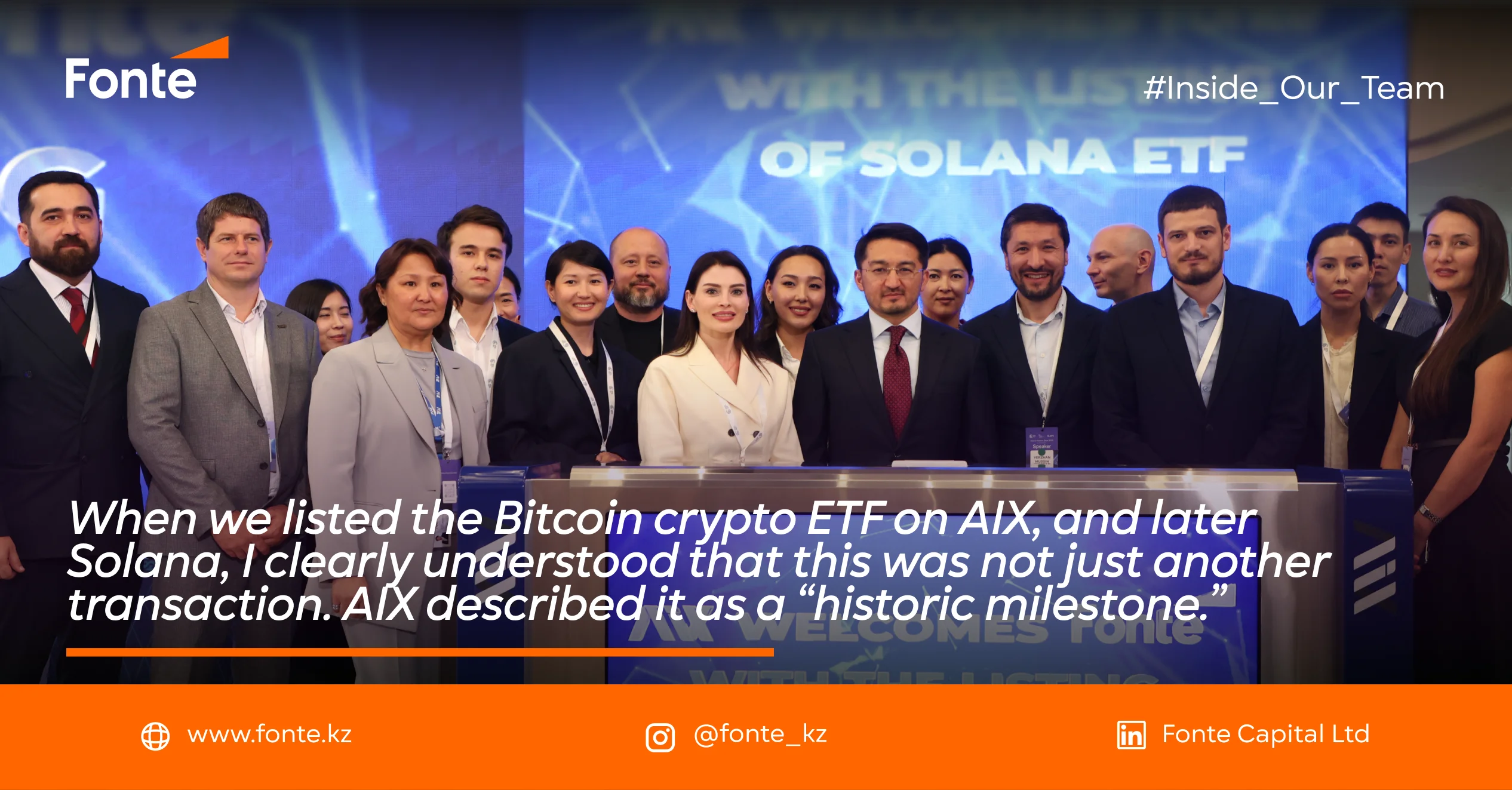
Yes. When we listed the Bitcoin crypto ETF on AIX, and later Solana, I clearly understood that this was not just another transaction. AIX described it as a “historic milestone.” Usually, such wording in press releases is routine courtesy. This time, it was genuine.
We made it possible for an investor in Kazakhstan to purchase a regulated digital asset instrument in a normal way — through an exchange, within a clear regulatory framework. That, I believe, was the moment.
What do you consider the key legal breakthrough in Kazakhstan’s investment market infrastructure in recent years?
I would answer briefly: the AIFC has finally proven capable of supporting complex structures. It may sound technical, but it is extremely important.
There is a significant difference between a regulator saying, “We have such a rule,” and a regulator actually registering the first umbrella fund with multiple sub-funds. The first is theory. The second is precedent — and once a precedent exists, the path is open for others.
The same applies to crypto ETFs. When we launched the first public Bitcoin ETF in Kazakhstan and Central Asia, it was not about a rule that theoretically allowed something. It was about a real instrument trading on an exchange within a clear regulatory framework. Then came Solana.
Infrastructure maturity reveals itself in such moments — when the system does not merely declare possibilities but implements them in practice.
In digital assets, regulation often lags behind technology. How do you build a dialogue between the regulator, business, and innovation?
I realized long ago that the approach of “please allow us” does not work well. The regulator is not an adversary, but it operates within its own logic — and in that logic, the key word is “control.”
So I speak that language. Not “this is an innovative product, let’s launch it,” but: here is the model, here are the risks, here is how we mitigate them, and here is why it aligns with your objectives. When the conversation is structured that way, the number of iterations decreases significantly.
The same applies to the exchange, the custodian, and the broker. Everyone must have a shared understanding. Because if the legal structure looks elegant but fails operationally, it is just a well-written document that does not work.
In your view, what does the portrait of a modern lawyer in an investment company look like?
Definitely not someone who simply says, “There is a risk here.” That is too easy and ultimately useless.
A strong investment lawyer understands the economic substance of the transaction. Thinks in scenarios: what happens if the market closes, if a counterparty defaults, if technology behaves unpredictably. Speaks the same language as investment, compliance, IT, and operations teams — and can switch seamlessly between them.
It is about managing risks, not merely listing them.
Is there a quality you had to develop in yourself to become the professional you are today?
Discipline and the willingness not to fear the new. When you work with instruments that have never existed before, you cannot wait for someone to explain how it should be done. You must quickly understand, make a decision, and bring it to completion — even if “no one has done it this way before.”
What motivates you to keep moving forward professionally?
Interest. Genuinely, curiosity about complexity. In investments, there is always something new that you have not yet done. For me, it is important to remain in that dynamic rather than switch to autopilot.
What helps you restore your energy?
Sport. Not because it is “a healthy lifestyle,” but because it is the only thing that truly resets the mind. After a good workout, a task that seemed overwhelming an hour ago usually looks quite manageable.
Do you have a motto that guides you in life?
“Do what you can, with what you have, where you are.”
It is not about accepting circumstances passively. It is about not waiting for the perfect moment, ideal conditions, or complete information — and simply acting.