
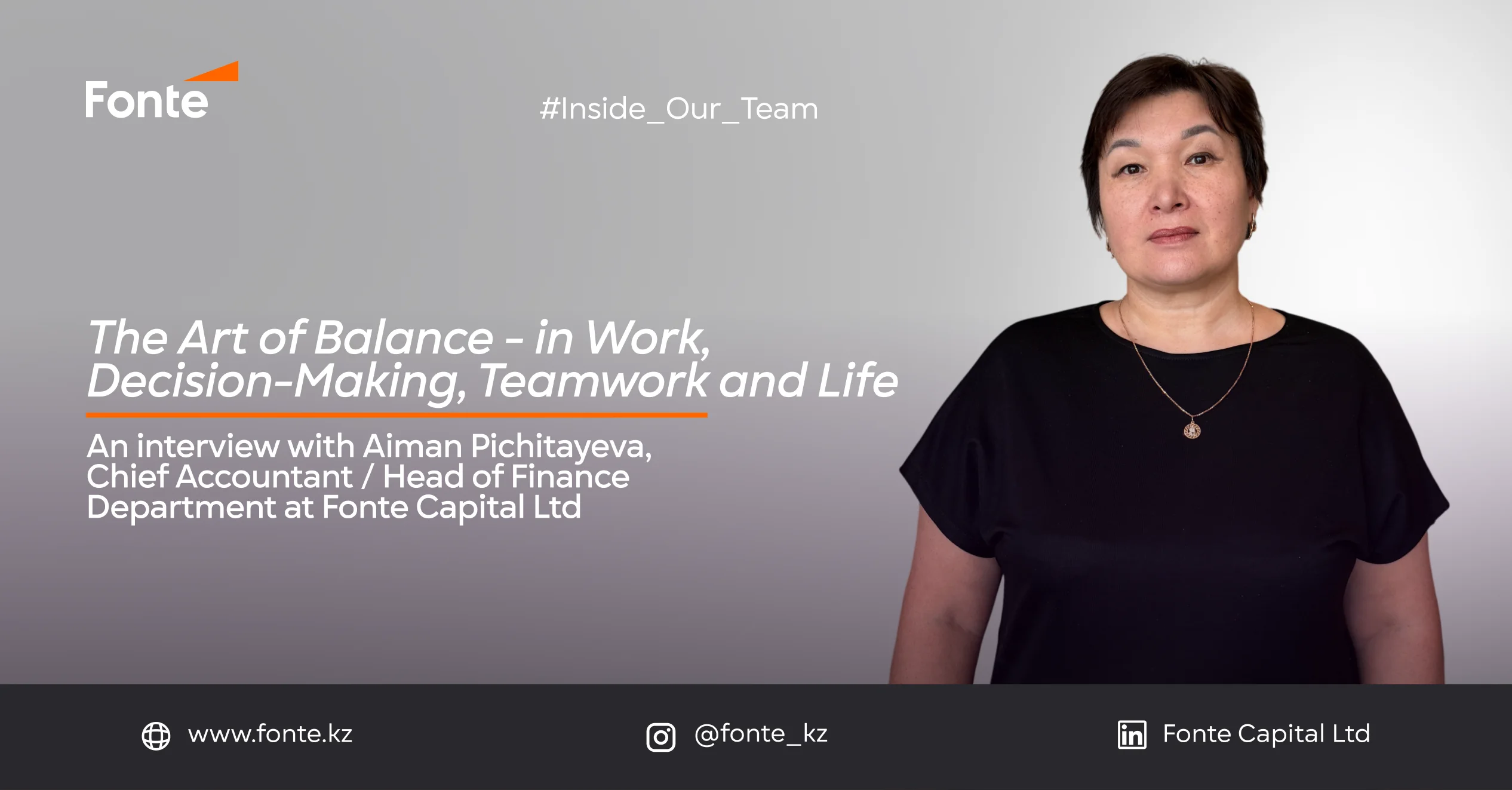
The Art of Balance - in Work, Decision-Making, Teamwork and Life
An interview with Aiman Pichitayeva, Chief Accountant / Head of Finance Department at Fonte Capital Ltd
Working in finance requires precision, discipline, and the ability to make well-balanced decisions even under significant pressure. Yet behind the numbers and complex investment instruments, there is always a person - their experience and professional principles.
In the new edition of Inside Our Team, Aiman Pichitayeva, Chief Accountant and Head of the Finance Department at Fonte Capital, shares her professional journey, the specifics of working in an investment company, the value of a strong team, and why maintaining balance across all areas of life is so important.
— How did your professional journey in finance begin?
- My career began in 1998, during a very dynamic and challenging period for the country. The banking sector was developing rapidly at the time, and for me, as a young professional, it was both an enormous challenge and a great opportunity.
Starting my career in banking immediately set a very high standard: strict professional requirements, a high level of responsibility, and the need to learn almost everything on the go.
— What has changed the most in the profession of a chief accountant over the years?
- The requirements for professional qualifications have increased significantly. Today, holding a professional accountant certification has become a mandatory requirement for chief accountants working in public companies and joint-stock companies.
In addition, a modern finance professional is expected to have a strong command of IFRS — International Financial Reporting Standards. This is no longer a profession in which you can afford to stand still: continuous professional development is essential, along with daily monitoring of changes in accounting and tax legislation.
— Which professional experience has been the most valuable to you?
- The most significant and fundamental experience for me was my work with subsidiaries of the National Bank of the Republic of Kazakhstan.
That period coincided with major reforms that were highly significant for the financial system: the transition to a four-digit chart of accounts, the transformation of accounting from national standards to IFRS, and the development of internal regulatory documents.
Another important stage involved projects focused on automating securities accounting and regulatory financial reporting, as well as participating in working groups developing amendments to the Tax Code.
These projects required a very high level of responsibility, but it is precisely large-scale and strategically important tasks that become the strongest drivers of professional growth.
— What qualities are particularly important for success in your profession?
- First and foremost, a genuine passion for numbers.
An accountant needs to approach every task thoughtfully and clearly understand how each figure entered into the system will ultimately affect the financial statements. Attention to detail and strict compliance with regulatory requirements are equally important.
Accounting touches virtually every area of life. For me, this profession is very much about finding and maintaining balance. And that balance has to exist not only on paper, in the form of financial indicators, but also internally — on an emotional or, if you like, energetic level.
When the numbers are in order, there is a sense of inner calm.
— How does accounting in an investment company differ from accounting in other industries?
- In most other industries, accounting consists largely of standard transactions. They are clearly defined in accounting policies, and there is an extensive body of established rules, instructions and interpretations.
In an investment company, the situation is very different. We work with a highly diverse and often unique range of financial instruments. Many business processes are simply not described in sufficient detail in local regulations.
As a result, we have to go much deeper into theory, study international practices and cases, adapt that experience to our own work, and then substantiate the accounting approaches we apply before auditors.
— What did you find most interesting when you first became involved in the work of Fonte Capital?
- First of all, the scale and complexity of the tasks.
I was immediately drawn to the extensive range of non-standard financial instruments the company works with. This is not routine accounting — each instrument requires an individual and analytical approach.
One particularly interesting and unique practice for me has been the accounting of each investor’s investments in separate “baskets”. Such a segregated accounting architecture requires exceptional precision, a deep understanding of investment processes, and the ability to build complex financial models.
For me, it was a challenge that allowed me to apply all of my accumulated experience while also finding new and effective solutions.
— What do you value most in your colleagues and in teamwork?
- For me, the overall atmosphere within the team is critically important.
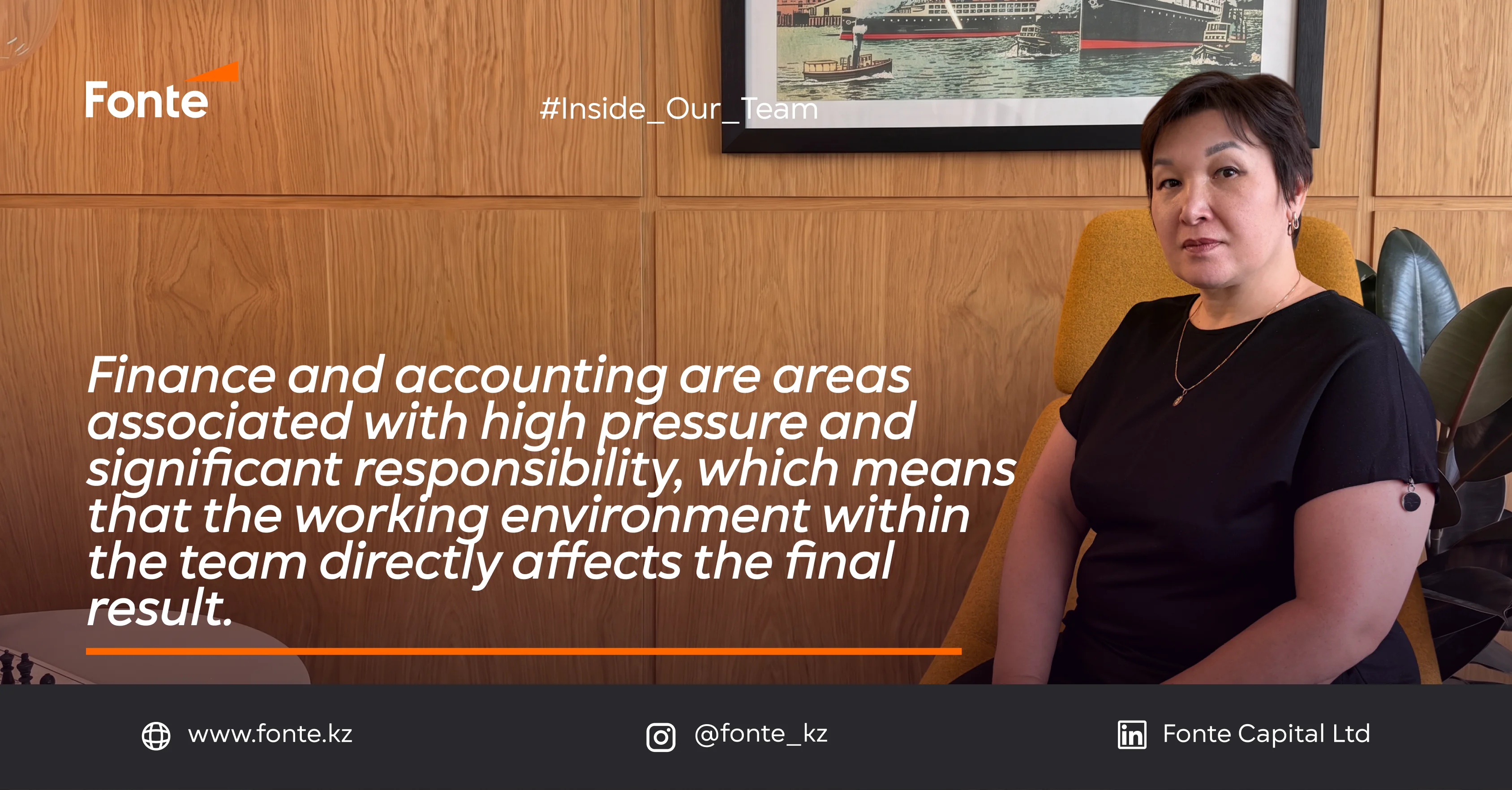
Finance and accounting are areas associated with high pressure and significant responsibility, which means that the working environment within the team directly affects the final result. Productive work is only possible where there is mutual respect, support and a healthy professional environment.
When it comes to personal qualities, I value a strong sense of responsibility, reliability and a deep, thoughtful understanding of one’s work.
I enjoy working with professionals who do not simply follow instructions mechanically, but who see the bigger picture, understand the value of their contribution, and are always ready to support their colleagues in difficult situations.
That is what a strong team is built on.
— How do you restore your energy after particularly intense periods at work? Are there any activities outside work that help you recharge?
- One of the peculiarities of working with numbers is that it can be difficult to leave them at the office — they often continue running through your mind even after the working day is over.
For me, the best way to switch focus is to change activities completely.
My greatest source of inspiration and strength is my family. I love spending time with my loved ones and drawing energy from their genuine emotions.
We especially value opportunities to spend time together in nature, as fresh air and natural surroundings are a wonderful way to reset after the intensity of city life and office routines.
I also believe that maintaining an active lifestyle outside work is essential for sustaining energy and balance. Physical movement provides the energy that later helps us manage even the most demanding intellectual workloads.
— Do you have a personal principle or motto that helps you both professionally and in life?
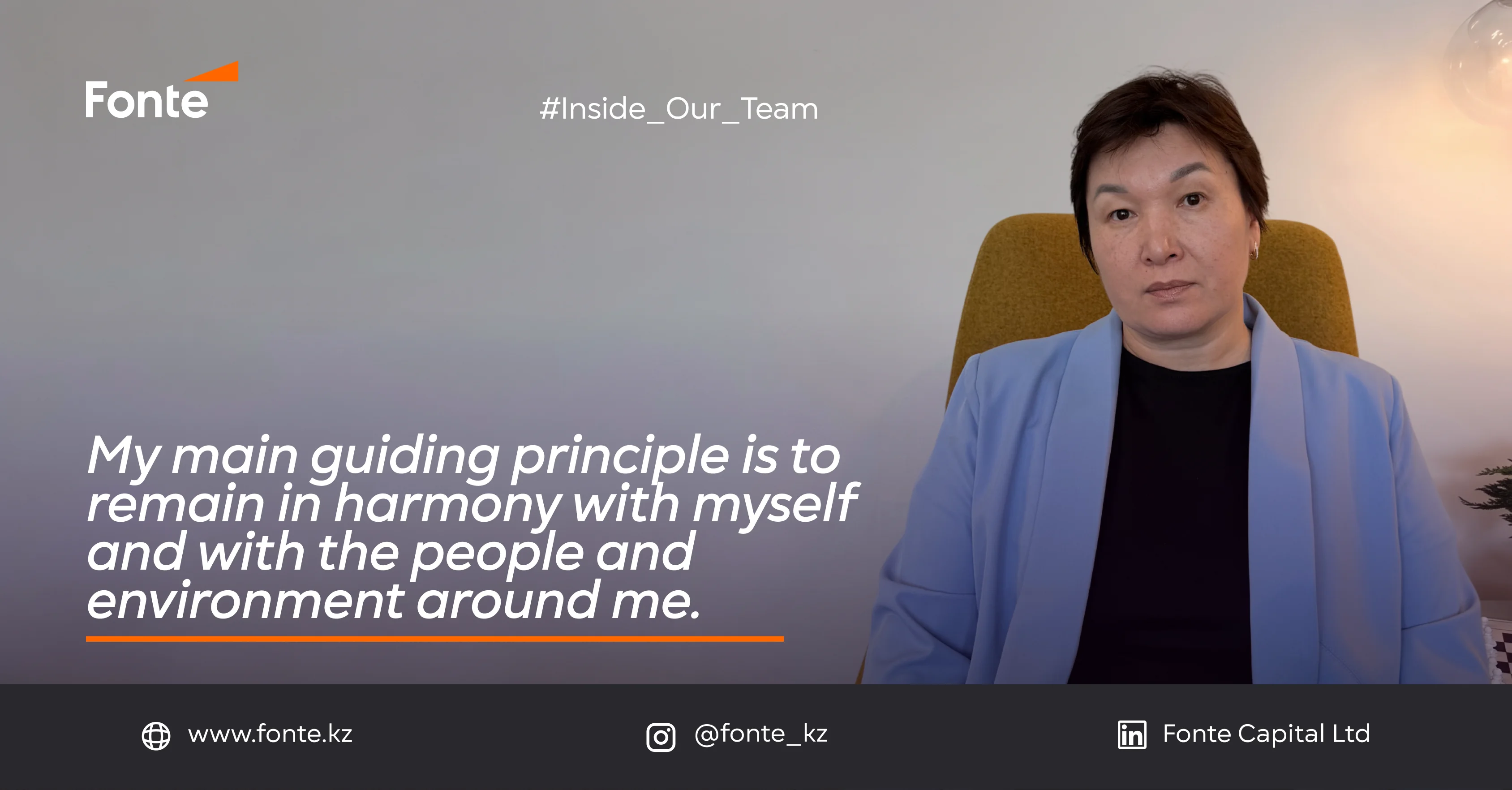
- My main guiding principle is to remain in harmony with myself and with the people and environment around me.
When that balance is achieved, external circumstances are much less likely to throw you off course.
When it comes to challenges and difficult tasks, I strongly believe that almost anything can be solved if you find the right approach.
In both work and life, there is no need to be afraid of difficulties. Very often, the right path can only be found through practice, trial and error.
That is how we gain the most valuable experience and develop the tools that ultimately allow us to achieve the best possible result.